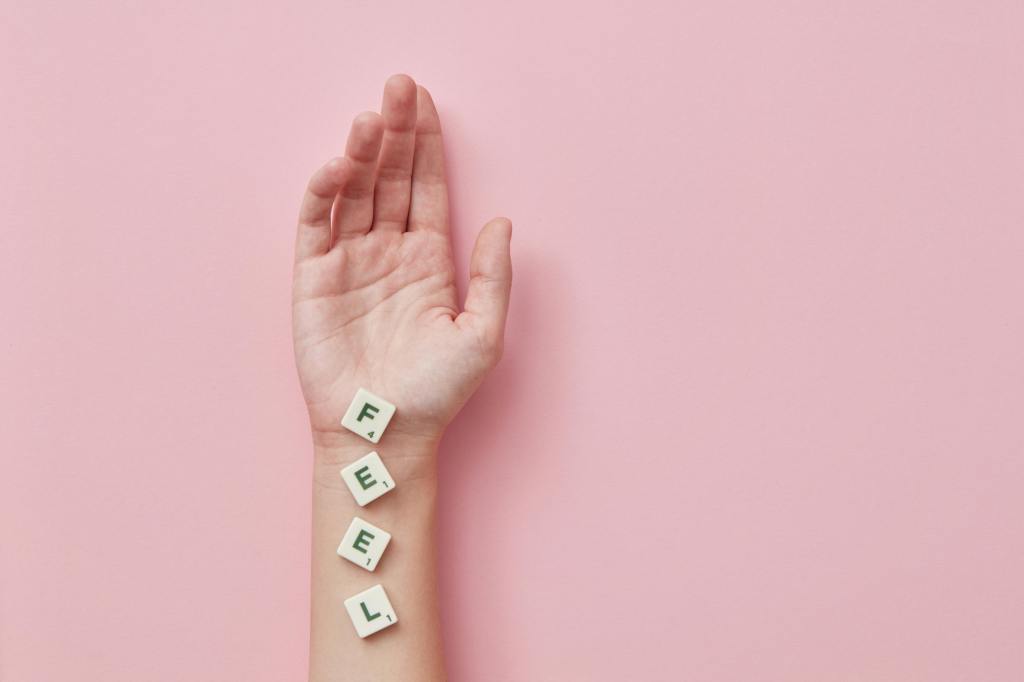
The problem with numbing out our negative feelings and experiences is, we also tend to numb out our positive ones, too.
Not always, but often. Very often.
Often enough that, when we’ve spent years, decades numbing out our pain, we often can’t remember what it’s like to feel even sort of good.
We often settle for feeling some facsimile of good— that, honestly, doesn’t feel all that good.
Understand: almost nobody reading this made a “choice” to numb out their feelings.
Almost everybody reading this was conditioned to do it, to some extent or another.
Blaming ourselves for it is a dead end.
Realistically regulating our feelings often begins with finding ways to feel our feelings— good, bad, and otherwise— in ways that aren’t overwhelming.
You have probably gotten all sorts of messages about your feelings over the years.
You’ve probably been told you’re “too much.”
You’ve probably been told you’re “too sensitive.”
You’ve probably been told your feelings are, to one extent or another, just…wrong.
So— you, like me, probably got in the habit of not feelings things.
Well…that kind of oversimplifies it, doesn’t it.
Because, after all, we do feel the things, don’t we.
Just not…consciously.
But we feel them.
In our bodies. In our dreams. In our fight, flight, freeze, fawn, and/or flop reactions.
Yeah. There’s no bypassing feelings, not really. And to the extent we try to bypass our feelings, we hand them power over us— notably, the power to interrupt our day, interrupt our relationships, interrupt our goals.
My point is, trauma recovery often involves reevaluating our relationship with our feelings— and our conditioned strategy of trying to opt out of feeling them.
Again: it’s not our fault.
But our feelings have been waiting for us to return to them, to acknowledge them, to care for them.
Trauma recovery broadly is about repairing and nurturing our relationship with ourselves.
For my money, every decision we make in recovery comes back to: does this build or chip away at my relationship with myself? With my parts? With my inner child?
Usually, if we can think to ask that Recovery Supporting Question, we can figure out the answer.
A super common, frequently misunderstood complex trauma symptom is, we survivors find it super easy to feel criticized.
It’s this nifty trick Trauma Brain plays, where it takes objectively neutral statements, and tries to tell us that we personally are being attacked or criticized.
Then it tells us we need to haul out our “fight” response, because the best defense is a good offense, right?
Mind you, we come by this habit honestly.
Many of us, like me, were raised by emotionally abusive narcissists, who never tired of finding was, subtle and not so subtle, to criticize us.
It makes a lot of sense that we’d develop the habit of inferring shade, even when no shade (or any intentionality at all) is present.
Want to know how “crazy” this can all feel? Trauma Brain gets me defensive when YouTube videos have provocative titles. “What, you think you know me, online platform that has zero stake in my behavior other than me clicking on the next video? Well, f*ck you!”
What’s happening when we sniff out “criticism” is, we’re being nudged (or plunged) into emotional flashback.
It’s that “in trouble” trigger that’s the fulcrum.
Many of us were raised with such shaky or nonexistent self-esteem, that we instinctively understand criticism— real or imagined— as the “obvious” precursor to abandonment or punishment.
Again: we don’t make this up for the hell of it. This reflects what we were raised with and in.
That is to say: we may feel “crazy”— emotional flashbacks are incredible at making us feel that way— but we’re not.
We’re actually responding the way injured, scared kids might respond.
Which is what we are on the inside, when emotional flashbacks occur.
Soothing ourselves when the “in trouble” trigger gets tripped draws upon the basic trauma recovery tools we spend every day developing: self-talk, mental focus, and breathing/physiology. Creating safety on the inside of our head and heart with how we talk to ourselves, how we direct our attention, and how we breathe and otherwise use our body.
You are not the first, last, or only trauma survivor to feel blindsided by “criticism” that, upon examination, may not actually be criticism (or even have all that much to do with you at all).
You are not “crazy.”
You are injured.
And shame does not heal injuries. Compassionate care and time do.
A useful frame for my own trauma recovery has been, this is me showing up for the me of yesteryear.
The me of my childhood, teenage, and even young adults years, who felt that nobody understood him.
Who felt that nobody liked him or was on his side.
My trauma recovery is about showing the me of the past, who I still carry around in my head and heart, that he did, in fact, deserve patience. And support. And acceptance.
Mind you, I’m quite aware that the me of the past had a lot going on inside his own head and heart.
I know that once upon a time I threw up plenty of barriers to people who might have been able to relate to me and understand me and support me.
I’m not saying it was all their fault.
But I now understand that the me of back then was injured in such a way that he didn’t know how to function without those barriers.
It wasn’t his fault, any more than it was the fault of the people around him. It was just the nature of my injury at the time.
I can’t go back in time and be there for that lonely young man.
I can’t go back in time and extend to him the patience and compassion that he was not shown by some of the people who should have shown it to him.
Time doesn’t work like that. (Believe me, I’ve researched it.)
All I can do, now, is care for myself and communicate with those past versions of me with care and understanding.
The truth is, the past version of both me and you carry wisdom for us.
Those past versions of us hold memories and experiences that can inform and support and enrich our life now.
They don’t just carry painful memories— though they may carry plenty of those— but they’re inside us holding the building blocks of who we are today.
Those past versions of us still need us.
I’ve always said, over and over again, that for my money the very backbone of trauma recovery is repairing and nurturing our relationship with ourselves.
Our relationship with ourselves is ultimately what complex trauma in particular damages.
If we’re going to repair and develop that relationship, we need to make peace with the kid— and teen, and younger adult— we once were.
That doesn’t happen by accident.
You and I should have had patience and support and compassion and acceptance once upon a time. It is not our fault that we didn’t get it (no matter how many barriers we may thrown up back then).
It sucks.
But we get to decide, every day, whether we’re going to deepen those wounds, or try to heal them.
That is to say: whether we’re going to stay on autopilot, or work our trauma recovery.
Because you’re “functioning” at a “high” level, doesn’t mean you’e not injured.
It doesn’t mean you’re not hurting.
It doesn’t mean what happened “wasn’t that bad.”
And it doesn’t mean you “don’t need” resources or support.
Many trauma survivors “learn” how to “function”— even when we feel overwhelmingly non-functional.
We learn this as a survival strategy.
We learn it as a distraction strategy.
We learn it as a way to convince other or ourselves that we are valuable or worthy, especially when we don’t feel particularly valuable or worthy.
Sometimes we don’t even understand how we’re “functioning,” given that we feel so sh*tty— enter the magic of dissociation.
Very often either we or someone else will hold out our level of “functioning” as “evidence” that we’re not REALLY all that injured.
They’ll hold out our academic or professional achievements, and and of raise their eyebrows. “Are you really all that hurt? Was it really all that bad?”
Yes, we are; and yes, it was.
No survivor’s academic or professional resume’ tells the whole story of their past or their pain.
And nobody looking at our story from the outside knows the true cost of those accomplishments.
Trauma survivors are real good at learning how to “present” well.
It’s a skillset we mastered in oder to minimize anyone’s awareness of our vulnerability— including ours.
If you learned to “function” at a high level, and if that “functioning” has come with rewards, I’m glad for you— you deserve credit for everything you’ve achieved.
But don’t let the fact of your success mess your head up about whether you were “really” hurt, or whether you “really” need or deserve help.
Achievements and “functionality” don’t tell the whole story.
Just ask the literal hundreds of PhD’s, medical doctors, scientists, executives, attorneys, and leaders who have walked through my door in the last decade.
There are lots of reasons people overtly “succeed” in our culture.
But “success” does not mean anything about what we did or didn’t experience growing up— or what we are or aren’t experiencing now.
And it absolutely doesn’t mean anything about what we do or don’t need or deserve now.
If there was a dramatic, one time “letting go” technique that let us “let go” of the past once and for all, believe me, I would tell you all about it.
I very much wish there was one.
I very much wish “letting go of the past” was as easy as all those people who tell us to “let go of the past” seem to think it is.
But— it’s not.
People who tell us to “let go of the past” don’t actually understand the injury of complex trauma.
It’s not us who won’t “let go of the past.”
It’s the past that won’t let go of us.
No survivor is out there right now voluntarily ruminating on the past.
No trauma survivor is out there right now cheerfully cataloguing ways they’re going to “let” their past interfere with their attachments and relationships now.
No survivor is out there right now gleefully anticipating how they’re going to “let” their past make them anxious, tense, and inexplicably angry around their superiors at work.
That is: no survivor “hangs on” to the past.
Those who have survived complex trauma find ourselves impacted by the past— and in trauma recovery, we intentionally set out to learn how we were impacted, and crafting daly habits of self-talk and mental focus to negate that impact.
People don’t understand: complex trauma, by definition, unfolds over time.
That means that complex traumatic stressors had hundreds of opportunities to make a dent in our nervous system. Hundreds of opportunities to condition and program us, over years.
That conditioning doesn’t just disappear with a one time “decision” to “let go of the past.”
Trauma recovery is about daily reconditioning and reprogramming— first and foremost, of our beliefs about and behavior toward ourselves.
That’s a day by day by day task. Not a dramatic, one time thing.
That’s why I keep saying: recovery is a lifestyle, not a goal.
Recovery IS the overall tool we use to realistically craft a quality life.
Don’t look for or hope for or bank on the dramatic “letting go” moment where you can leave all this behind.
Instead, focus on the minute by minute micro choices, especially in how you talk to yourself; focus your attention (the sliver of attention you can influence, anyway); and utilize your physiology, especially your breathing.
We let go of the past in increments— and those increments look like teeny, tiny changes in behavior.
You are going to run into a bunch of stuff in this CPTSD recovery journey that won’t seem to make a lot of sense.
You’re going to run into memories that don’t seem to fit in with the rest of your life story.
You’re going to run into feelings that seem wildly disproportionate to anything you’re thinking or anything that’s happening to you right now.
You’re going to run into reflexive relationship behaviors that leave personal and professional bonds you value in tatters.
You’re going to find yourself twisted up in knots over self-care behaviors, even down to bathing and brushing your teeth, that other people seem to take for granted— and you’re going to have no earthly idea why.
One of the frustrating things about struggling with complex trauma is, so much of what we’re dealing with is just outside of our conscious awareness.
The conditioning that is ruining our life is mostly implicit— that is, we don’t wake up every morning and “decide” we’re going to think, feel, and do things that kick our own ass.
Trauma responses are not “choices.”
The very nature of conditioning is that it grooms us to think, feel, and do things without thinking, without choosing, and often in opposition to what we actually want or value.
The reason why I keep using the term “Trauma Brain” is to drive home the fact that what can look to others like “choices” are not, actually, being “chosen” by us— they’re conditioned responses installed by the abuse and neglect of our bullies and abusers, often years or decades ago.
Our conditioned trauma responses may very often sen “crazy” to us.
So many survivors have the experience of thinking, feeling, and doing things that seem to have absolutely nothing to do with what we actually want or value— and having absolutely no idea why.
That’s how conditioning works. Trauma Brain is coercive, by definition— even if we seem to be “doing it to ourselves” in the absence of any obvious external threat.
When we’re caught in cycles of thinking, feeling, and doing things that we don’t understand and seem to be ruining our life, it’s temping to get frustrated with or aggressive toward ourselves.
Again and again and again I’ve met survivors who berate themselves for their symptoms or their choices— which doesn’t seem to have any affect on what they think, feel, or do.
I’m going to ask you, no matter how frustrated you are with yourself, to try to reel that in.
I’m going to ask you to not call yourself “crazy.”
I’m going to ask you to not try to shame or punish yourself out of these thoughts, feelings, and behaviors that, I know, I understand, don’t seem to have anything to do with who you actually are or what you actually want for your life.
The core of trauma recovery is rebuilding— or maybe just building for the fist time— a safe, supportive relationship with ourselves.
That means, no matter how incomprehensible our thoughts, feelings, or choices are, we don’t flip over into shame or self-punishment.
If we want our nervous system, our endocrine system, our “parts,” our subconscious mind, and our inner child to work with us, instead of against us, we need to make the inside of our head and heart a safe place for ourselves.
That is: we can’t have our own body and mind living in fear or expectation of an attack from the inside out.
“Self trust” and “self love” may seem like kind of fluffy, abstract terms, but in my book, they are fundamental to CPTSD recovery— and they are only created when we engage with our own thoughts, feelings, and behavior with compassion, acceptance, and patience. Even— especially— when we don’t like our own thoughts, feelings, or behavior.
Yes, you’re going to run into plenty on this recovery journey you won’t quite understand, that will confuse you, annoy you, exasperate you.
I’m going to ask you to do something hard with all of that— something your abusers and bullies would NEVER do.
I’m going to ask you to accept it.
Not like it, not love it, not give up on changing it— but accept it. Radically accept it all.
What’s more: I’m going to ask you to validate it. Validate where those “crazy” thoughts, feelings, and behaviors are coming from, anyway— the pain and survival needs that gave birth to this thoughts, feelings, and behaviors.
If you really want those thoughts, feelings, and behaviors to start working with you instead of against you, if you really want to understand and transform them— begin by accepting and validating them.
Our trauma conditioning is real good at screeching at us that we’ve “failed.”
Trauma Brain, what I call the internalized voices of our bullies and abusers, seems to find an endless variety of ways to inform us that we are a “failure.”
Trauma Brain tells us we “fail” at relationships.
Trauma Brain tells us we “fail” at managing our finances.
Trauma Brain tells us we “fail” at managing our emotional reactions.
Trauma Brain tells us we “fail” to make good choices.
And on, and on, and on.
To spoil the suspense: Trauma Brain will never tell us we’re good at something, or that we did something better than we expected to, or that our success at something was kind of a mixed bag.
Through the magic of the cognitive distortions of black and white thinking, emotional reasoning, and mental filter, Trauma Brail will stay remarkably on message: that we are a “failure.”
Here’s the thing: it is the case that trauma survivors experience tend to experience challenges and struggles with…well, everything Trauma Brain flatly declares us to have “failed” at.
But you need to know that struggling is not the same as “failing.”
Everybody who has ever succeeded or gotten better at dong a thing, has struggled with it.
The fist step to actually being good at doing a thing is, well, sucking at it.
One of Trauma Brain’s insidious tricks is trying to tell us that we’ve “failed” at something we’re struggling with— because the fact of our struggle seems to give its argument a germ of credibility.
After all, most of us trauma survivors are VERY aware of the things at which we struggle.
And if we weren’t aware, Trauma Brain is “helpfully” right there reminding us— often repeating not only the words of our bullies and abusers, but also amplifying the feedback we get from others around us who don’t understand why we can’t just get our sh*t together.
An important step in our trauma recovery is gaining clarity about what’s actually happening when we supposedly “fail” at something that we imagine “most” adults don’t struggle with at all: we’re not, actually, “failing.”
We are doing the thing as best we can, with the tools we have.
We’ll get better at doing the thing the more tools we develop— and we develop new tools as we make it safe inside our head and heart to work on those tools without judgment or shame.
Understanding this was a game change for my own recovery.
It also felt like a risk.
My father was an abusive, addicted narcissist who had created enormous wealth and material success in his life— and he, among others, strongly conditioned in me an abhorrence of “making excuses.”
If I explained to my father the difference between “failing” and “struggling,” I am positive he would mock me for “making excuses.”
I always assumed my dad was a wealthy man, because of his material success— but now I understand that he wasn’t particularly wealthy. Not really.
He was just a guy with money.
People who create real success, real wealth, understand the difference between “struggling” and “failing.”
Yes, accepting that difference may feel like a risk, because Trauma Brain— who, in my case, often speaks in the voice of my father— will tell you you’re being a “loser” and setting yourself up for even more “failure” by “letting yourself off the hook.”
But distinguishing between struggling and failing— properly understanding struggle as a necessary point in the developmental curve of building a skill— is not “letting yourself of the hook.”
It’s not making excuses.
It’s getting real about how skills are learned, tools are developed, recovery is shaped, and a successful life— even beyond trauma recovery— is built.
Abusive families resemble cults in many respects— and evoke many of the same symptoms and struggles in their victims.
Complex trauma is trauma that unfolds over time, is entwined with our important relationships, and is functionally inescapable— and those criteria absolutely apply to abusive families as readily as they apply to cults.
In many abusive families, individual needs are subordinated to a functionally authoritarian head of the household— in much the same way cult acolytes are expected to subordinate their individuality to the will of an authoritarian leader.
In abusive families, there is often a “code of silence” that is expected to be maintained by family members to protect the families’ secrets and hide the behavior of abusive family members— much like there is a “code of silence” that is expected of cult followers to protect their leaders.
Abusive family members, especially adults, often exploit younger family members’ vulnerability in order to gain sexual or other access to them— tactics identical to abusive cult leaders who prey on their followers.
Abusive families can “brainwash” vulnerable family members just as surely as abusive cults can, and through many the same tactics, even— including the deprivation of basic needs in order to gain compliance and adherence.
Both abusive families and abusive cults exploit “in group” and “out group” psychological tactics to create fear in family members or followers, to minimize the chances that someone will “tell” on the family or cult to outside authorities.
The pain inflicted by abusive families is rarely limited to one domain, but most often includes a combination of physical, emotional, and sexual abuse; and this is also true of abusive cults, which also frequently mix in spiritual and financial abuse on top of those.
Victims of familial abuse often feel shame for staying in their family’s orbit for as long as they did— much like cult followers frequently belittle themselves afterward for not recognizing what was going on sooner.
Both abusive families and cults often cite religious principles or authority as justification for controlling family members’ or followers’ lives—which very often head f*cks family members’ or followers’ attempts to detach from them.
Family members who have been abused very often struggle to imagine that their attempts to leave the system will be successful— they very often believe that, even if they try to leave their families, they’ll never “really” be able to leave, in much the same way cult leaders convince their followers that there is no salvation or peace outside of the group.
It can be hard for many people to accept that their family was abusive— but it might help to step back and look at their family’s behavior and dynamics from the perspective of, “would this check out if we were talking about a cult, instead of a family?”
Taking that step back and seeing those similarities can be a real eye opener.
Victims of abusive families and victims of abusive cults often experience similar CPTSD symptoms upon leaving they respective situations.
Both abusive families and cults infiltrate survivors’ beliefs about themselves, the world, and the future.
Both abusive families and cults do everything in their power to gaslight their victims into silence and complacency, even after they’ve left.
The culture often thinks of both abusive families and cults as relatively rare phenomena, but victims know: there are far more abusive families and cult-like groups out there than many people realize.
Both victims of abusive families and cults need to know what CPTSD is and what CPTSD recovery entails.
And neither victims of abusive families nor abusive cults are to blame for their experience.
Nobody dissociates to be a pain in the ass to anybody else. (Believe me, dissociation is a much bigger pain in the ass to trauma survivors who dissociate than it is for anybody else— if we had the choice, we’d find a much less fraught way to annoy you.)
Nobody “chooses” dissociation as a coping tool.
Dissociation is a reflex— and, like most reflexes, it exists to keep us away from pain or danger.
Why would we dissociate to avoid pain or danger?
Usually the reason is because we literally had no other way out of that pain or danger.
Dissociation is escape for people who can’t physically escape.
This is what so many people don’t understand— or maybe don’t want to understand— about dissociation: that not everybody can “just leave” a dangerous situation.
Domestic violence victims very often cannot “just leave” a relationship on which they are economically dependent or in which children are a factor.
Victims of spiritual abuse often can’t “just leave” a church or community that is their main or only source of social contact and support.
Children cannot “just leave” a family in which they are being abused or neglected.
Complex trauma survivors who do not know, in the moment, that they are experiencing complex trauma cannot “just leave,” because they don’t yet realize there is anything to escape.
There are dozens of reasons why physical escape from pain or danger is simply not a realistic option for many.
As a result, our nervous system “solves” this “no win” problem by inventing a “back door”— namely, dissociation.
Sometimes that dissociation looks like just “checking out” or “floating away.”
Other times, especially when we need to stay or appear highly “functional,” dissociation looks like a “part” of ourselves coming forward to do what needs to be done in the moment, while the rest of us “loses” the time that part is “out.”
And still other times, dissociation looks like some aspect of our experience, such as our emotions or our memory of specific things, being made inaccessible to us, so we can “function” for a period of time without feeling the “weight” of what’s been dissociatively cordoned off.
There’s no denying that dissociation is an ingenious strategy for “escaping” situations in which there is no practical or physical escape, at least in the short term.
I strongly believe any realistic trauma recovery strategy needs to give dissociation and the “parts” of ourselves that have gotten us though tough moments their due.
Any recovery “strategy” that shames us for dissociating (or shames any other symptom) is not realistic or sustainable. Actual trauma recovery never begins with shame and is never supported by shame.
It is the case that, if we’re serious about taking back our life from complex trauma, we need to make ourselves less vulnerable to dissociation as a symptom— but that is not the same as shaming ourselves for it or making our “parts” disappear.
We need to remember that if we’re reflexively dissociating, that means some part of us is in flashback or otherwise feeling panicked or threatened— and we need to look inside to understand what’s getting triggered and how we can be there for ourselves.
It’s not that dissociation is “bad” or “wrong.” It’s a symptom, and symptoms, while often inconvenient or destructive, are not “bad” or “wrong.”
It’s that we need to take seriously what dissociation is trying to tell us about what’s going on in our nervous and endocrine system right now— and we need to ask intelligent questions about what we need.
This isn’t about “staying present” for its own sake.
This is about committing to not ignoring or abandoning “parts” of ourselves stuck in “trauma time” inside.
Making the inside of our head and heart is always worth the effort— and when and how we dissociate is going to show us where to start with that commitment.